
Elevation: 954 feet
Prominence: 235 feet
Isolation: 2.13 miles
Summit coordinates: 42° 18′ 3” N, 72° 35′ 13” W
Town: Hadley and South Hadley, Massachusetts
Conservation Area: J.A. Skinner State Park / Mount Holyoke Range State Park
Links:
Mount Holyoke on Peakbagger
Mount Holyoke on ListsofJohn
Mount Holyoke on AllTrails
Skinner State Park website (including trail map)
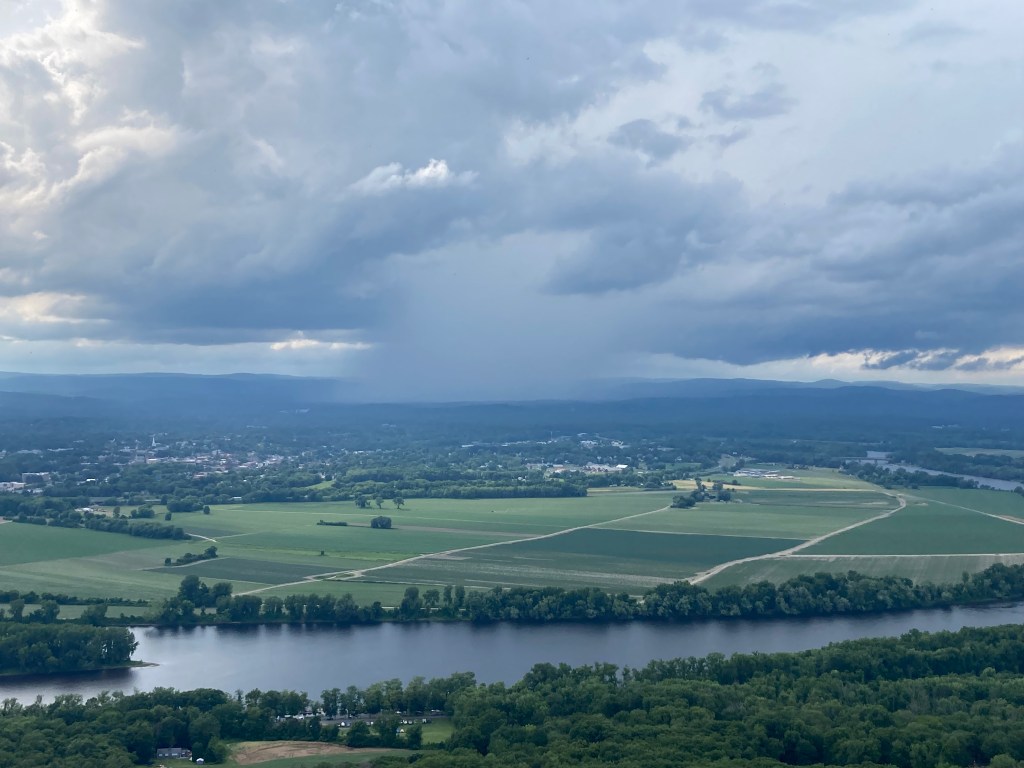
General info: With its stunning views, summit historic site, and great trails, Mount Holyoke would definitely be on my short list of favorite peaks in Massachusetts. It forms the westernmost peak of the Holyoke Range, the dramatic east–west ridge that runs along the south edge of the Pioneer Valley. Even though it is not especially high by Massachusetts standards, the mountain stands sharply above the surrounding farmland, offering some of the finest valley views in western Massachusetts, including the famous Connecticut River oxbow, Amherst and Hadley to the north, and the Berkshire foothills to the west. The historic Prospect House, one of the best-preserved 19th-century mountaintop resort hotels in New England, located atop Mount Holyoke, offers a fascinating glimpse into the past (see historical background below). The summit is protected within J.A. Skinner State Park, which features a seasonal auto road as well as a network of hiking trails. The Metacomet–Monadnock Trail / New England National Scenic Trail runs over the mountain, linking it to the rest of the Holyoke Range.
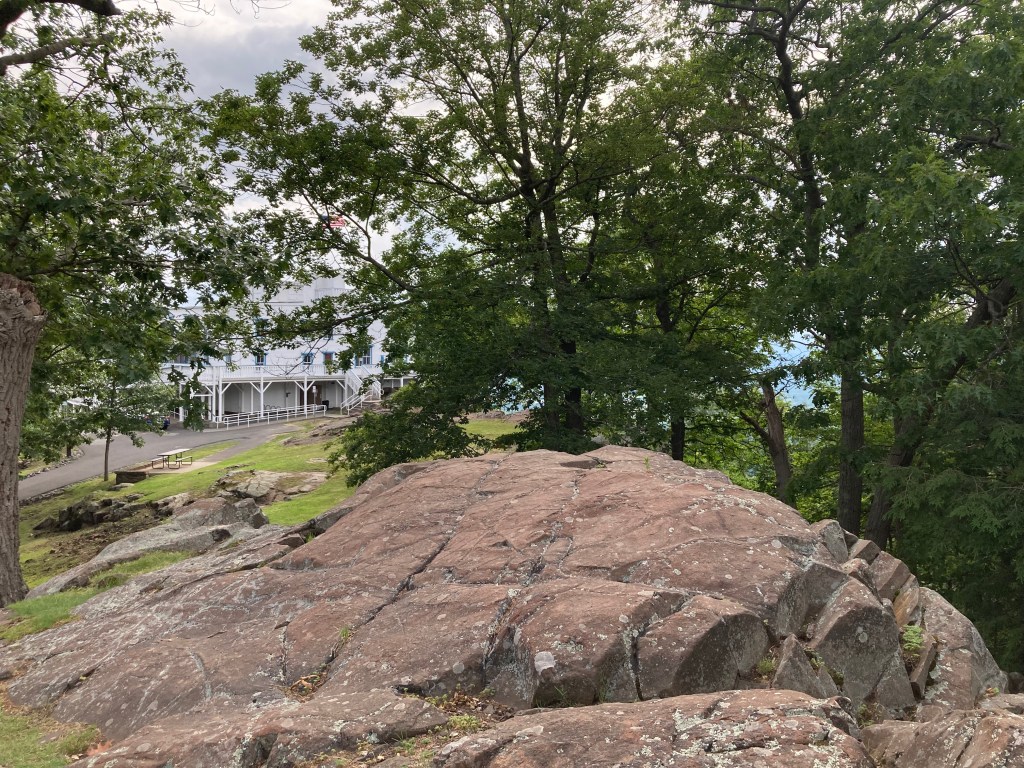
Geologically, Mount Holyoke is composed of basalt (traprock) formed about 200 million years ago when lava flowed across the valley floor during the breakup of Pangaea. Over time, the layers tilted and eroded into the cliffs and ledges we see today. The dry, sunny ridgetop supports unusual plants and wildlife compared to the cooler forests below, making the mountain as interesting ecologically as it is scenic.
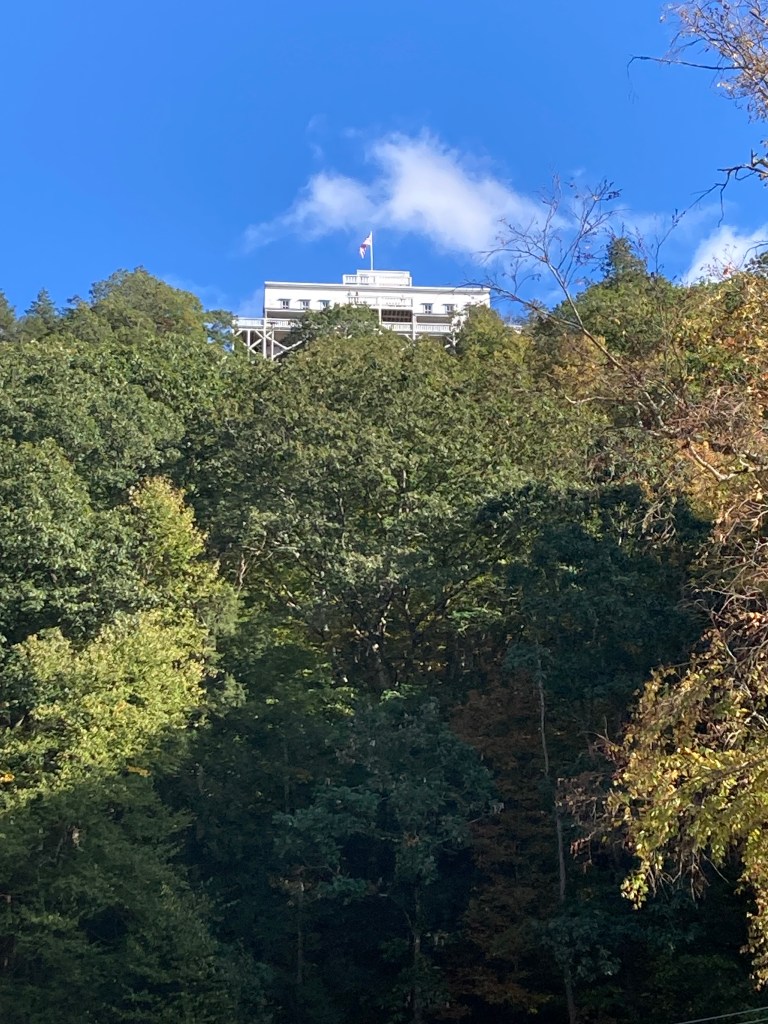
Historical background: Mount Holyoke was one of the earliest developed mountain resorts in New England, beginning in the early 19th century as people started to see upland vistas as destinations in their own right rather than obstacles to travel. In 1821, a small cabin was constructed near the summit to offer visitors shelter and refreshments, capitalizing on the breathtaking views over the Connecticut River Valley that would later inspire Thomas Cole’s famous 1836 painting, The Oxbow.
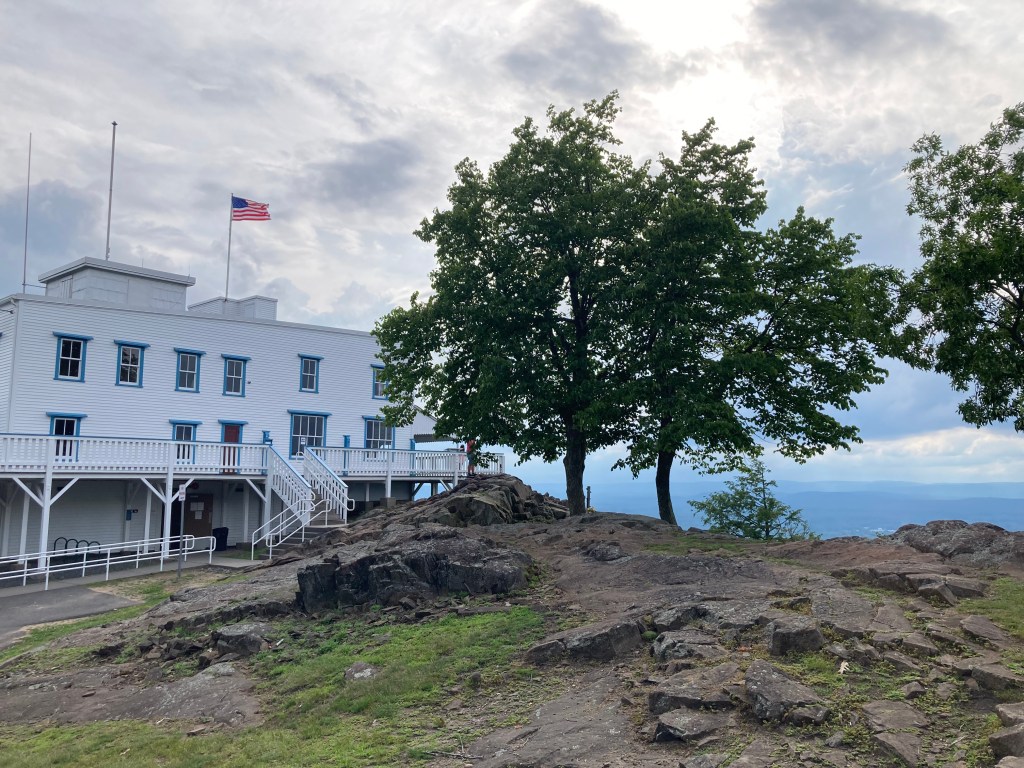
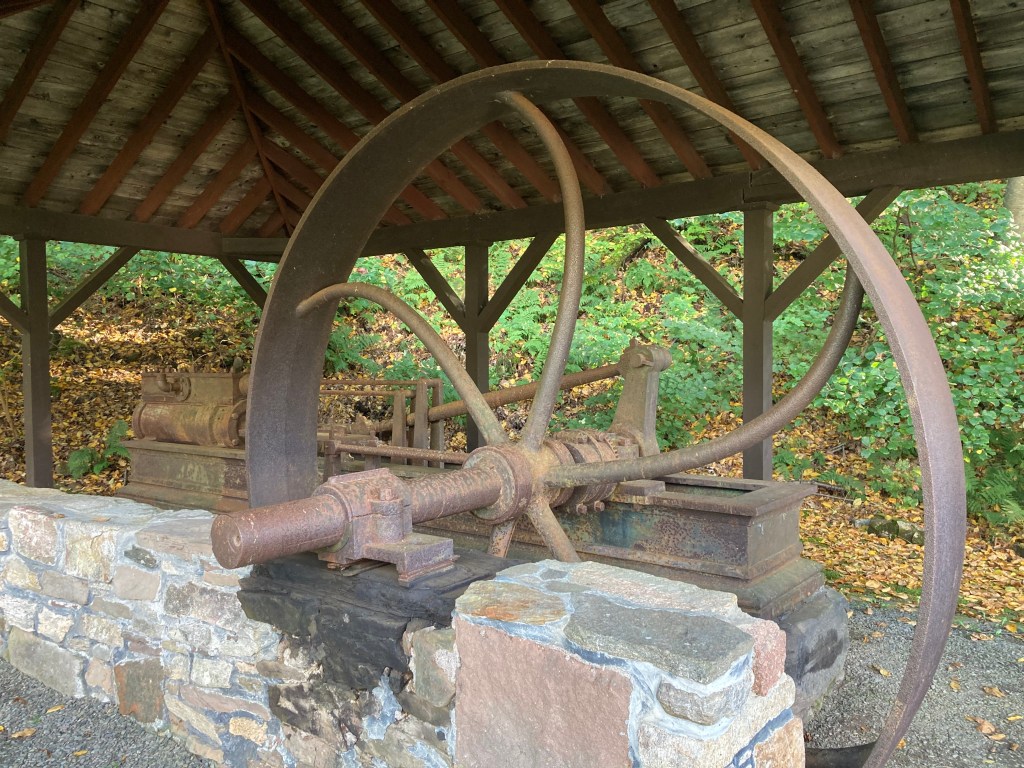
In 1849, Northampton bookbinder John W. French and his wife Frances (Fanny) purchased the summit property and soon replaced earlier structures with a more substantial hotel — the Prospect House — built in 1851. The original building was a two-story hotel with eight guest rooms, a dining room, sitting room, and office, and featured a cupola with a telescope for visitors to enjoy the views. As the mountain’s popularity grew, access improvements followed. In 1854, French built one of the first inclined tramways in New England, initially to haul supplies up the steep slope and later adapted to carry passengers directly into the hotel’s lower level. The Prospect House was substantially expanded in 1894 under later owner John Dwight. This large addition increased lodging capacity to around 40 guests and included a dining room that could seat about 200 people.
The rise of the automobile and changing vacation patterns in the early 20th century made distant and more accessible destinations increasingly desirable. The summit resort began to decline, and it suffered significant damage in the Great New England Hurricane of 1938, when the large 1894 annex was destroyed. Shortly afterward, industrialist Joseph Allan Skinner donated the hotel and surrounding lands to the Commonwealth of Massachusetts on the condition that they be preserved as a public park. The state formally dedicated what became J.A. Skinner State Park in 1940.
The defunct tramway was removed in 1965 after decades of safety concerns. Some proposals even called for the demolition of the Prospect House, but local advocacy led to its restoration in the 1980s as a historical landmark and interpretive site. Today, the original 1851 core of the building and the 1861 enlargement survive, and the restored Summit House operates seasonally as a museum and scenic overlook.
Recommended ascent routes: There is a good-sized parking area at the gate to Skinner State Park on Old Mountain Road in Hadley. This is the logical starting point for any hike that involves Mount Holyoke. Here are a few suggestions…
New England Trail/Two Forest Trail Loop: One of my favorite short hikes. This moderate route takes you up the New England Trail along the spine of Mount Holyoke. There are several nice vistas along the way. After exploring the summit you can take the Two Forest Trail or the paved road back down for a family-friendly hike of about 3 miles and 730 feet in elevation gain.
Skinner State Park Road: The seasonal auto road makes it possible for people of all ages and abilities to enjoy the sweeping views from the summit, whether you arrive on foot or by car. A walk up the paved Skinner State Park Road is about 3.3 miles and 600 feet in elevation gain. The road will take you past the Halfway House where those staying at the Hotel would disembark from carriages and board the tramway up the face of the mountain. Little remains of the tramway now but there is some interesting interpretive signage.
New England Trail to the Notch Visitors Center: A more ambitious hike involves leaving two cars, one at the Notch Visitors Center on Route 116 in Amherst and another at the main gate of Skinner State Park. The hike in between will take you over four peaks of the Holyoke Range for an overall hike of about 6 miles and 1,625 feet in elevation gain.
Click to enlarge photos:
 Hiking Massachusetts Peaks
Leave a comment