

Mass 50 Public Peaks elevation rank: #20
Elevation: 2,240 feet
Prominence: 270 feet
Isolation: 2.02 miles
Summit coordinates: 42°05’13.2″N 73°30’16.9″W
Town: Mount Washington, Massachusetts
Conservation Area: Mount Washington State Forest (MA) / Taconic State Park (NY)
Links:
Alander Mountain on Peakbagger
Alander Mountain on Listsof John
Alander Mountain on AllTrails
Mount Washington State Forest website (with trail map)
General info: Alander Mountain is a prominent 2,240-foot (683 m) peak in the southern Taconic Mountains of Massachusetts, straddling the New York border. The mountain’s summit and east slope lie in Massachusetts (town of Mount Washington), while the west side extends into New York (Copake). The summit itself is an open, grassy area with scrub oak and low shrubs, which allows for panoramic vistas uncommon in the region. The mountain’s slopes are densely wooded. Most of Alander Mountain is protected public land. The east side is within Mount Washington State Forest (Massachusetts) and the west side lies in New York’s Taconic State Park. These connected parks ensure the mountain’s habitats remain undeveloped. Notably, the state forest harbors about 300 acres of old-growth northern hardwood forest in various pockets, meaning parts of Alander’s slopes have never been logged and feature ancient trees. Overall, Alander Mountain offers a unique combination of ecology and scenery with well maintained trails set in a rugged protected landscape.
Historical background: The history of Alander Mountain reflects the broader story of Mount Washington and the South Taconic region—rugged, remote, and only lightly touched by colonial and industrial development. Old maps refer to the peak as both “Elk Mountain” and “Alandar Mountain.” Alandar was also the name of a small village in Mount Washington located just east of the mountain, though it’s unclear which was named for which. The village name has fallen out of use, and its origin remains uncertain.
European settlement in the area began in the late 18th century. The western slopes of Alander Mountain were part of the vast Livingston Manor (a New York land grant), while Massachusetts settlers claimed the plateau on the ridge. In the mid-18th century, feuds known as the “Taconic War” or “Border War” erupted in this region, as tenant farmers in the Taconic hills defied the Livingstons and aligned with Massachusetts to gain clear title to their land. These disputes were eventually resolved through a treaty between the two states in 1786. When the state boundary was first drawn, it continued southwest in a straight line from Alander, placing the land to the south within Massachusetts. This isolated corner, known as Boston Corner, was cut off from the rest of the Commonwealth by the high Taconic plateau—of which Alander Mountain forms a part—and was virtually inaccessible from the Massachusetts side. Because the area was far easier to reach from New York, Massachusetts ceded Boston Corner to that state in 1855, fixing Alander Mountain as the extreme western point of Massachusetts. Oddly, there is no marker for this point that I’m aware of, but the spot is slightly west of the summit, just a bit downhill.
After the Revolution, families like the Brazees, Hallenbeecks, and Loomises established farms in the surrounding valleys and lower ridges near Alander by the 1790s. But the steep, rocky slopes of Alander Mountain itself were poorly suited to farming, and while some forest clearing occurred, the mountain remained largely wild. Unlike nearby towns such as Salisbury, Connecticut—where iron mining took hold—Alander saw little industrial use. By the mid-1800s, many farms had been abandoned or consolidated, and the landscape gradually returned to forest.
In 1927, the Taconic State Park Commission built a 60-foot fire tower on Alander’s summit, along with a small cabin for fire watchers. A telephone line connected the site to the valley below. But the tower’s stay was brief—by 1930, the landowner had revoked permission, and the tower was dismantled. Its components were later reassembled on Washburn Mountain, and eventually moved to Beebe Hill in New York, where it still stands today. The original summit cabin remains on Alander, though now in deteriorating condition.
In 1958, Massachusetts established Mount Washington State Forest, ensuring permanent protection for Alander Mountain as part of a growing network of conserved land. Thanks to its rugged terrain and early preservation, the mountain has retained much of its untamed character.
Recommended ascent routes:
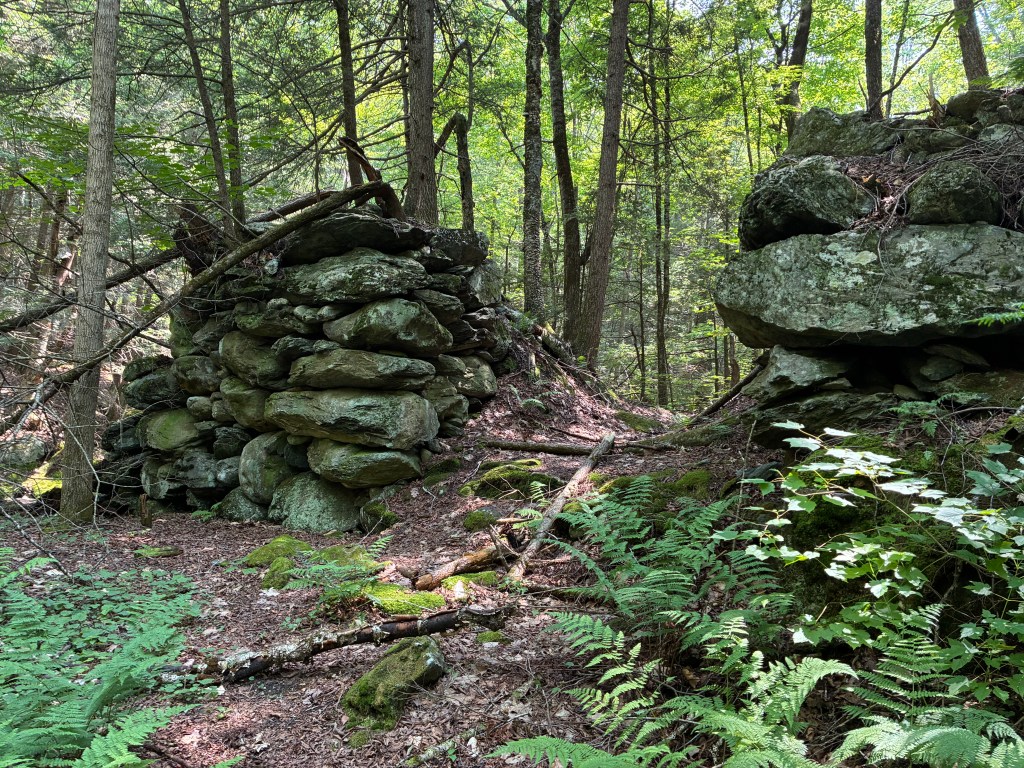
Alander Mountain Trail (Massachusetts side) – Mount Washington State Forest HQ to Alander Summit: The most popular route begins at the MA State Forest headquarters on East Street, Mount Washington. From the trailhead, it’s about a 6 mile out-and-back hike (round-trip) with roughly 1,200 feet of elevation gain, making it a moderately challenging half-day hike. The trail (blue-blazed) winds through woodlands and alongside brook valleys (keep an eye out for the impressive remains of a mill foundation by the confluence of Ashley Hill Brook and Lee Pond Brook) before climbing steeply up Alander’s east slope.
Alander Brook Trail (New York side) – Western approach via Taconic State Park: Alander can also be climbed from the NY side for those coming from New York or looking for a different perspective. I haven’t tried this approach, but the most direct route is from the Taconic State Park parking area on Under Mountain Road. The route is shorter but steeper and with more elevation gain. About 4.4 miles and 1,600 of vertical gain.
Nearby Listed Peaks: There are definitely routes on AllTrails that combine Alander Mountain and nearby Mount Frissell. A little challenging for me at about 10 to 12 miles depending on the route, but for those accustomed to longer hikes, it’s certainly an option. Mount Darby and Prospect Hill, also on the Highest 50 Public Peaks list, are nearby to the north. Again, further than I would want to hike but theoretically within reach by foot. Mount Everett is also nearby to the east, though connective trails are lacking. And, given Everett’s elevation and prominence, I would think most would want to save it for a separate trek.

 Hiking Massachusetts Peaks
Leave a comment